
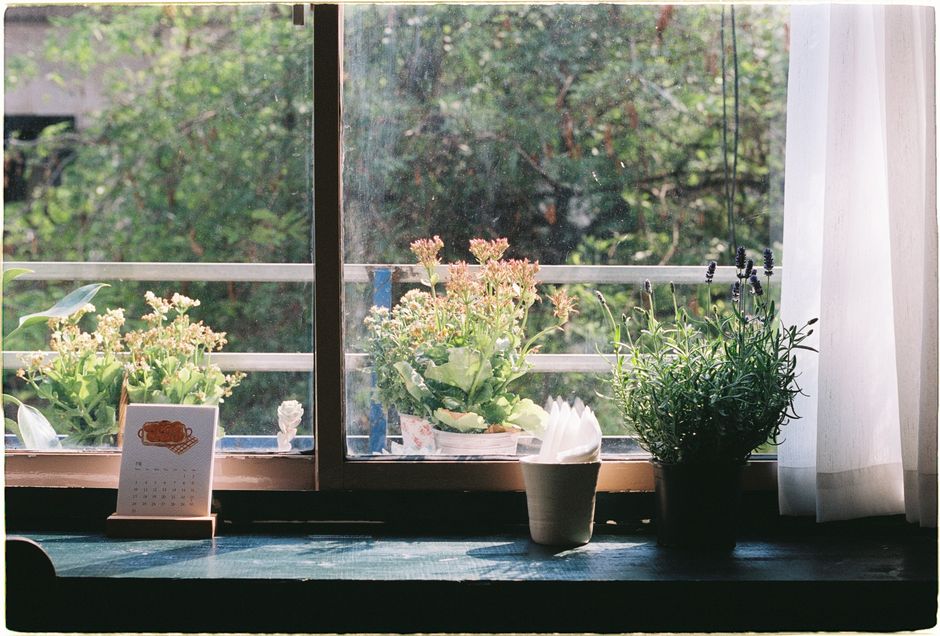
You did everything the sleep articles told you to do. Blackout curtains, thick ones, the kind that cost more than the rod. Phone charging in the hallway. Room at 18°C. No coffee after two. And still, at 11:40 p.m., you are lying there wide awake with a brain that has decided now is the ideal moment to review a conversation from 2019.
Here is the part almost nobody tells you: the problem probably isn't your night. It's your morning. You spent the whole day in a room that your body, biologically speaking, could not distinguish from dusk — and then you asked it to fall asleep on schedule.
Your eyes are not a camera. They're a clock.
Most of us think about light in terms of seeing. Enough light to read, not so much that it's harsh. That's the visual system, and it's remarkably good at adapting — which is exactly the problem, because it makes a dim room feel perfectly normal.
But you have a second light system running underneath the visual one. A small set of cells in your retina, discovered only in the early 2000s, don't contribute much to what you see at all. They report one thing to the brain's master clock: how bright is it out there, right now? That signal is what tells your body whether to be in day mode or night mode — when to release cortisol, when to warm up your core temperature, and, roughly fourteen hours later, when to start making melatonin.
These cells are tuned to a specific slice of blue-ish light, which is why researchers stopped measuring circadian light in ordinary lux and started using melanopic EDI — a unit weighted for what that clock system actually responds to. It's a different scale from the one your light bulbs are sold in, and it explains a lot of confusion.
Your visual system adapts to a dim room in about a minute. Your body clock never does. It just quietly concludes that the sun didn't come up today.
The numbers are more brutal than they sound
Here's where it gets uncomfortable. In 2022, a group of circadian researchers published a consensus set of indoor lighting recommendations in PLOS Biology. Three numbers, measured at eye level:
| Time of day | Melanopic EDI target |
|---|---|
| Daytime | at least 250 lux |
| Evening (3+ hours before bed) | under 10 lux |
| Sleep environment | under 1 lux |
Now compare that to where you actually spend your hours. A typical office is lit to somewhere between 300 and 500 ordinary lux — which sounds like it clears the bar, until you account for the fact that melanopic EDI runs lower than the raw lux figure under most indoor lighting, and that the number is measured vertically at your eye, not horizontally on your desk. Sit in the middle of a room instead of by the window and the level can collapse to something in the tens of lux.
Then step outside. An overcast morning is around 10,000 lux. A clear sunny day is roughly 100,000. Field measurements have found outdoor locations running about eight times brighter than indoor ones even on unremarkable days — and that gap widens enormously in direct sun.
So the honest summary is this: stepping outside for ten minutes will do more for your body clock than any bulb you can buy for your living room. Not because outdoor light is magic, but because the intensity gap is an order of magnitude, and intensity is the entire mechanism.
What actually happens when people fix this
The research here is refreshingly concrete. In one study, participants spent a week letting daylight into their apartments and a week keeping the blinds drawn. During the bright week, they fell asleep an average of 22 minutes earlier, slept on a more regular schedule, and reported being more alert and in better mood during the day.
Twenty-two minutes is not a miracle. But it's the same order of magnitude as what people are chasing with supplements, apps and expensive mattresses — and it came from opening the blinds.
A separate survey of roughly 700 people found that those who either spent one to two hours outdoors daily or worked in a brightly lit space were less likely to report trouble sleeping or symptoms of anxiety. That's correlational, not proof, and the direction could partly run the other way — people who feel better go outside more. But it lines up with the mechanistic picture, and the intervention costs nothing.
The clinical end of this literature is stronger still. Bright-light exposure in the morning, on the order of 30 minutes at high intensity, is a standard tool for shifting a delayed body clock earlier. It's used for seasonal mood disorders and for people whose sleep timing has drifted badly out of phase. The everyday version is the same lever, applied gently.
The morning routine that actually matters
None of this requires a new device. It requires putting light in the right place in your day.
Get outside within an hour of waking. Not through a window — glass cuts a meaningful share of the intensity, and you'll typically be facing the wrong direction anyway. Ten to twenty minutes on a bright day; thirty or more if it's grey and grim. Walk the dog, take your coffee to the doorstep, get off the bus one stop early. The activity is irrelevant. The photons are the point.
Don't wear sunglasses for that first stretch — assuming there's no medical reason you need them and you're not staring at the sun, which you should not do. The whole exercise is about letting light reach your retina.
Sit near the window if you have any say in it. The difference between a desk by the glass and a desk in the interior of the same office is not subtle. If you're working from home, move the desk. It is the cheapest circadian intervention available.
Repeat it at roughly the same time each day. A regular light-dark cycle is more useful than one heroic Saturday morning. Consistency is doing as much work here as intensity.
If you only change one thing: leave the house within an hour of waking, without sunglasses, for ten minutes. That's the whole intervention.
The evening half — where most people over-correct
The blue-light conversation has been so thoroughly commercialised that it's worth being precise about it. The evening target above — under 10 melanopic lux — is genuinely low. Lower than most living rooms. But two things follow that people usually get wrong.
First, intensity matters more than colour. A dim warm lamp and a dim cool lamp are both fine; a bright warm lamp is still bright. Dimming your overheads does more than swapping every bulb for amber. If your fixtures have a dimmer, this is what it's for.
Second, screen distance is doing a lot of quiet work. A phone held 30 cm from your face delivers considerably more light to your eye than the same screen a metre away. Moving the laptop back, or dropping the screen brightness, is a bigger lever than a blue-light filter that leaves brightness untouched.
And for the bedroom itself, that under-1-lux target is a real one — this is where blackout curtains, which we started by mocking, genuinely earn their price. The mistake was never buying them. The mistake was buying them instead of fixing the daytime side.
A realistic week
Here's what a reasonable version looks like, without turning your life into a protocol:
- Morning: outside within an hour of waking, 10–30 minutes depending on the weather, no sunglasses.
- Working hours: as close to a window as you can manage; step outside at lunch even briefly.
- Two to three hours before bed: overheads off, lamps low, screens dimmed and further from your face.
- Bedroom: as dark as you can make it, including the standby LEDs you've stopped noticing.
Give it two weeks before you judge it. Circadian shifts are gradual by design — the system is built to resist being yanked around, which is why jet lag takes days to clear rather than hours.
What this doesn't fix
Light is a powerful lever, not a cure. Chronic insomnia, loud snoring or witnessed pauses in breathing, sleep that stays broken despite good habits, or daytime sleepiness severe enough to affect your driving or work — those warrant a conversation with a doctor, not a longer morning walk. Sleep apnoea in particular is common, treatable, and completely unaffected by how much sunlight you get. If your sleep problems come with low mood that persists, that's also a reason to talk to a professional rather than optimise alone.
This article is general information, not medical advice for your situation.
The short version: your body clock reads brightness, and indoor life gives it a permanent dusk. The fix isn't a gadget — it's ten minutes outside in the morning, a desk closer to the window, and dimmer evenings. One study found a week of daylight moved sleep onset 22 minutes earlier. That's a decent return on opening the blinds.
Tomorrow morning, before you check anything, open the door and stand outside for ten minutes. Your clock has been waiting to hear from the sun.


